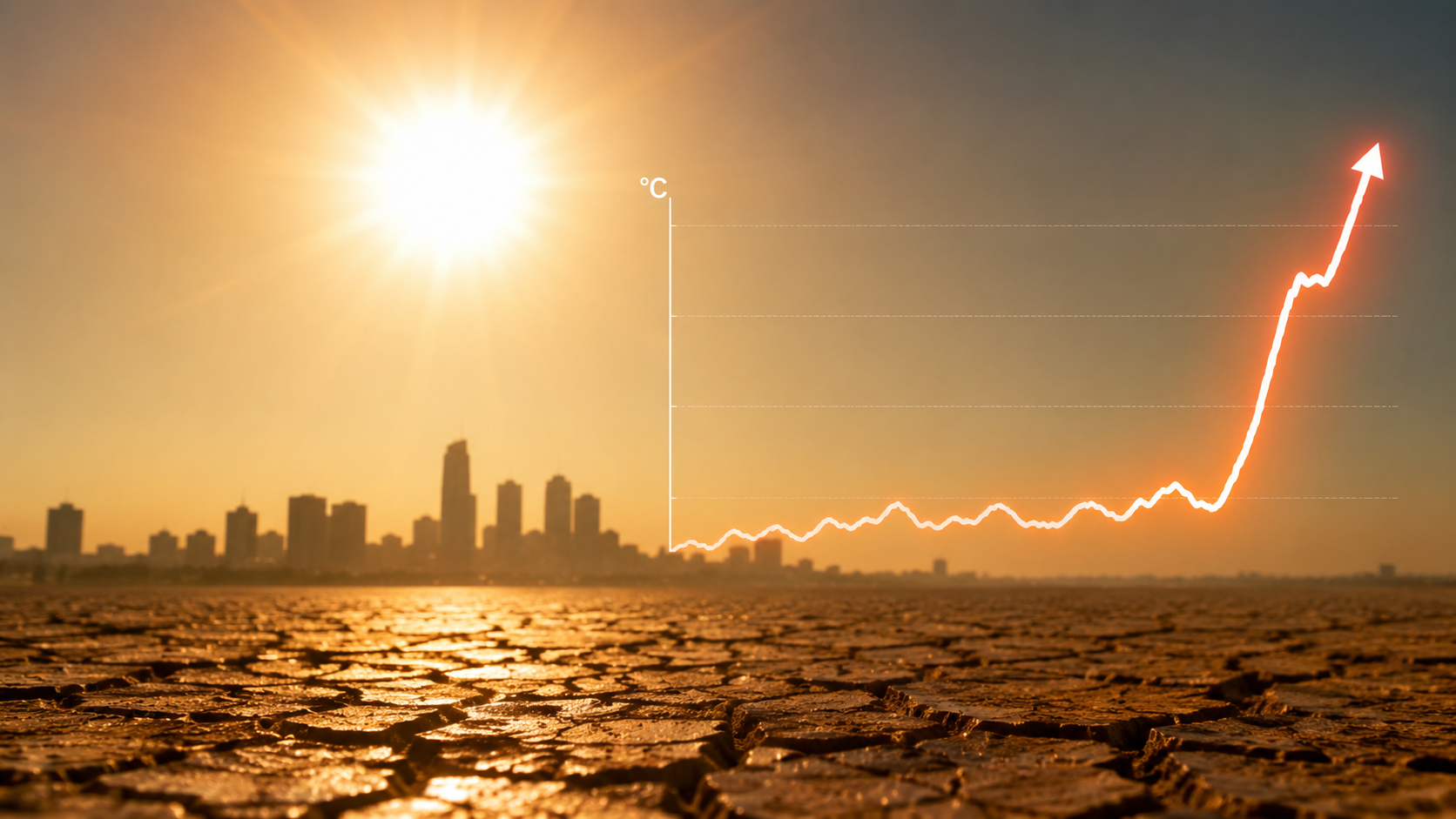
An early and historic heatwave
France is not only facing a period of hot weather. Since June 17, 2026, the country has been experiencing a heatwave whose intensity already places it among the major meteorological events in its recent history.
According to Météo-France, Tuesday, June 23 became the hottest day ever recorded at national level since records began in 1947. The national thermal indicator reached 29.8°C, exceeding the previous record of 29.4°C measured on July 25, 2019 and August 5, 2003.
The previous night had already set another record. From Monday, June 22 to Tuesday, June 23, the average minimum temperature across mainland France reached 21.6°C, making it the hottest night ever recorded in metropolitan France. Exceptionally high nighttime values were measured locally, including 28.7°C in Pouzauges, in Vendée, and 27°C in Saint-Léger-la-Montagne, in Haute-Vienne.
On Wednesday, June 24, 58 departments were under red heat alert, mainly across the western two-thirds of the country, while 31 others remained under orange alert. Temperatures exceeded 40°C in several areas, with 44.3°C recorded in Pissos, in the Landes department.
The consequences go far beyond discomfort. Schools have closed or adapted schedules, trains have been cancelled or slowed, tourist sites have reduced opening hours, and public authorities have repeatedly urged caution. Dozens of drownings have also been reported since June 18, as people sought relief in swimming areas, sometimes unsupervised.
This heatwave is particularly striking because of its timing. Météo-France notes that heatwaves usually affect mainland France between early July and mid-August, although they are increasingly occurring outside this period. June 2026 is a stark example. Just weeks earlier, at the end of May, France had already experienced an unusually early heat episode: May 26, 2026 became the hottest May day ever recorded in the country, with a national average temperature of 24.8°C.
This repetition is not an isolated anomaly. It is part of a documented trend: global warming is making heatwaves more frequent, earlier and more intense. Public climate adaptation data in France estimates that by 2050, under a +2.7°C warming scenario, summer rainfall could decrease by around 10% in mainland France. Soil droughts would become longer and more intense, with an average of 24 additional days of soil drought. Extreme drought events could last four to five months in northern France, and up to seven months in Mediterranean regions.
Visible consequences for gardens and agriculture
These numbers are not only relevant to national climate reports. They can also be seen in a garden.
In vegetable gardens, the effects appear quickly. Young plants wilt during the day. Lettuce goes to seed faster. Tomatoes and peppers may suffer from excessive radiation. Flowers can abort under heat stress. Bare soil dries out, loses its coolness and then its ability to retain water. Watering routines that once worked may no longer be enough, or may become impossible when water restrictions increase.
Professionals face the same pressures at a larger scale. In May 2026, the agricultural institute Arvalis described an unusual situation for cereal crops, combining earliness, intensity and duration of heat. In some regions, crops were already advanced when the heat episode occurred, increasing risks for grain filling and yields.
This connection between heat, soil, water and food production is central. A heatwave does not only raise temperatures. It changes evaporation, accelerates maturation, weakens young plants, disrupts harvests, reduces working hours for farmers and increases irrigation needs precisely when water becomes more constrained.
A health and food-system warning
From a health perspective, heat is not a secondary risk either. Santé publique France estimated that summer 2025 was associated with more than 5,700 heat-attributable deaths across the monitoring period, including more than 1,900 during heatwave episodes.
The current heatwave is therefore a warning. It puts pressure on bodies, infrastructure, crops and habits. It reminds us that food depends on fragile balances: weather, water, soil, transport, energy, harvests and the ability of local areas to organise themselves.
Local resources that often remain invisible
Yet part of local food resources already exists, without always being visible.
In a village, neighbourhood or town, a lemon tree may produce more fruit than one family can eat. A garden may produce too many courgettes for two weeks. Seedlings may remain unused. Seeds may sit in a drawer. Herbs may grow in excess on a terrace. Surplus harvests may be given, sold cheaply or swapped, but only if people know they exist.
Today, these exchanges often depend on chance: a conversation between neighbours, a post in a local group, a basket left outside a house. This has value, but it remains limited. It makes the regular circulation of local resources difficult, at a time when food is becoming more local, more seasonal and more sensitive to climate extremes.
Digital tools can strengthen local exchanges
This is where local digital tools can play a role.
Not to replace farmers, markets, local producers or shops, but to complement them. To make scattered resources visible. To facilitate exchanges that would otherwise never happen.
Seeed was built with this idea in mind. The app helps users discover nearby gardens, small productions, fruits, vegetables, seeds and plants. It is designed for people growing herbs on a balcony, amateur gardeners, households with a vegetable garden, shared gardens and small producers looking for more local visibility.
Users can offer surplus produce, give, sell, reserve or swap locally. They can also discover what grows nearby, connect with people in their area and join a local community around gardening, harvests and short food circuits.
Seeed does not claim to solve the climate crisis or the fragility of food systems on its own. Its promise is more modest, but concrete: to make better use of what already exists around us.
Building food resilience through proximity
In a country where heatwaves are becoming earlier and more severe, this local approach matters. Sharing seedlings, avoiding food waste, finding nearby produce, supporting small-scale growers and passing on locally adapted seeds will not replace national adaptation policies. But these actions help build a culture of resilience.
Extreme heat forces us to look at gardens differently. They are no longer only leisure spaces. They are sensitive indicators of water availability, soil health, real seasonality and a territory’s ability to produce and share.
The question is no longer only how to protect a garden during a heatwave. It is also how to connect gardens, harvests, growers and local residents.
In a France already adapting to longer, hotter and more uncertain summers, food resilience will not be built only in fields. It will also be built through proximity.