Europe's wildfire season is reaching another level
France is experiencing what Reuters describes as its worst wildfire season on record.
On 14 August, a new wildfire in the Landes had already burned around 1,100 hectares and forced 525 residents to evacuate Luglon, with 500 firefighters and six aircraft deployed.
Large fires are simultaneously affecting several European countries.
Belgium was fighting its largest wildfire on record on 16 August, while major fires have also affected Spain, Greece, Croatia and the United Kingdom.
Firefighting aircraft and emergency services remain essential.
But another question is becoming increasingly important:
can landscapes themselves be designed to make wildfire spread more difficult?
Agriculture may be part of the answer.
Fire needs continuous fuel
Wildfires spread through vegetation.
Dry grass, shrubs, branches and trees provide fuel.
When this vegetation forms a continuous landscape, flames can move from one area to another.
France's Ministry of Agriculture therefore includes fuel breaks among the tools used to prevent and contain forest fires.
Roads and forest tracks can provide these breaks.
But managed agricultural land can sometimes play a similar role.
Vineyards can change fire behaviour
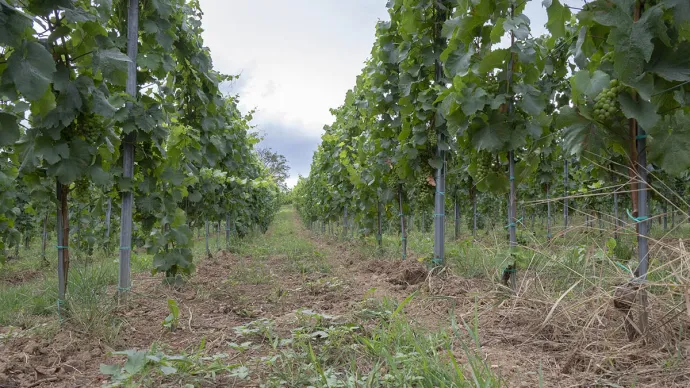
A maintained vineyard is very different from dense woodland.
Vines are planted in rows, vegetation is managed and access tracks often cross the landscape.
This does not make vineyards fireproof.
Powerful wildfires can cross vineyards, destroy vines and ruin harvests.
But managed farmland can create areas with less continuous vegetation, potentially giving firefighters more defensible terrain.
Abandoned farmland creates another challenge
This became particularly visible after the devastating Corbières wildfire in southern France in 2025.
The fire affected nearly 16,000 hectares, including around 2,000 hectares of farmland, more than 1,000 hectares of vineyards and roughly 200 farms.
At the same time, France's wine industry is experiencing a structural crisis.
In June 2026, the European Commission approved a new French programme supporting the permanent removal of vineyards as producers respond to falling wine consumption.
When cultivated vineyards disappear and land becomes unmanaged scrub, the structure of the landscape changes.
The challenge is therefore not necessarily to preserve every vineyard.
It is to decide what happens to land after agricultural production ends.
Pastures, orchards and new crops could maintain open landscapes
Former vineyards do not necessarily have to remain vineyards.
Some areas could potentially transition toward grazing land, orchards, olive groves, drought-adapted crops or agroforestry systems.
The goal is not to replace natural ecosystems with agriculture.
Instead, strategic agricultural areas can form part of a broader mosaic separating forests, settlements and infrastructure.
Livestock can help manage vegetation
Grazing is another ancient tool gaining new relevance.
Sheep, goats and cattle remove herbaceous vegetation and can help maintain more open areas.
In suitable landscapes, grazing can therefore combine food production with vegetation management.
It cannot replace regulated brush clearing or professional wildfire prevention.
But it demonstrates how agricultural activity can serve several functions simultaneously.
Agriculture can also start fires
There is an important warning.
Farming is not automatically protective.
The French government states that nine out of ten wildfires are caused by human activity, with agricultural work among the potential sources of ignition.
Machinery operating in extremely dry fields can create sparks or accumulate combustible vegetation.
Agricultural practices therefore also need to adapt as fire danger increases.
The wildfire map is changing
Major French wildfires were historically associated primarily with Mediterranean regions and Corsica.
That is no longer the full picture.
France's Agriculture Ministry says wildfire risk is now potentially present across the entire country.
Climate change does not directly ignite most fires.
Human activity still causes most ignition events.
But hotter and drier vegetation creates conditions in which those fires can become much more destructive.
Food production and landscape protection can overlap
Maintaining local agriculture therefore has value beyond food production.
Farmers maintain fields, orchards, vineyards, pastures, tracks and hedgerows.
In some fire-prone regions, keeping these landscapes actively managed could increasingly become part of climate adaptation.
This is also one reason local food networks matter.
Seeed helps gardeners, individuals and producers give, sell or swap fruit, vegetables, seeds, plants and other local products with people nearby.
Supporting local producers does not directly stop a wildfire.
But keeping agricultural land economically active can help preserve diverse, managed landscapes rather than allowing every abandoned parcel to become continuous unmanaged vegetation.
Resilience comes from diversity
Future landscapes will need forests.
They will need biodiversity and natural ecosystems.
But they will also need farms, orchards, vineyards, pastures, hedgerows, wetlands and settlements arranged intelligently together.
No single element provides perfect protection.
The strength comes from the mosaic.
In a hotter climate, local food production may therefore provide something beyond food: it can also help maintain the landscapes in which we live.
Sources
- Reuters – New wildfire forces 525 people to evacuate in southwestern France, 14 August 2026
- Reuters – Wildfires spread across Europe, 14 August 2026
- Reuters – Belgium battles its largest wildfire on record, 16 August 2026
- French Ministry of Agriculture – Preventing and fighting forest fires
- French Ministry of Agriculture – Forest protection, climate and wildfires
- French Ministry of Agriculture – Agricultural impacts of the Corbières wildfire